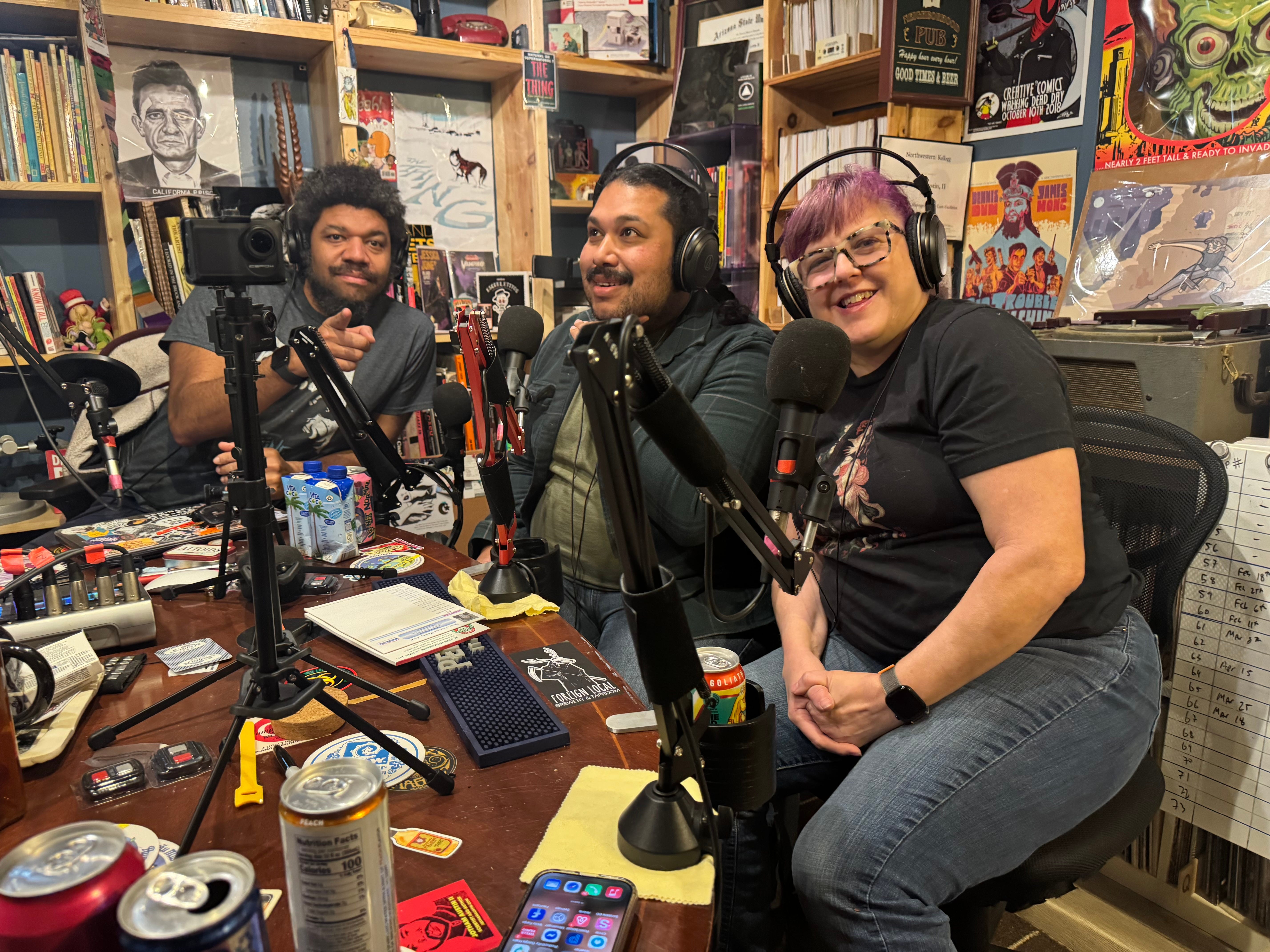


In Episode 75: The Mini, Joe, Nick, and Georgia recap Episode 74: Scorpion and the Other Chimeras — part two of their Spider-Man villain series featuring guest Erin C. Anthony, evolutionary ecologist and middle school science teacher — and dig into a few things that didn’t make it into the full episode.
Joe explain what organoids are, tiny, self-organizing 3D tissue cultures grown from stem cells that can mimic actual human organs, and why they are important in biomedical research. Including what happened when they sent some into space on the Artemis II mission.
Georgia wants to know more about the explosive diarrhea outbreak, caused by the microorganism Cyclospora cayetanensis, spreading across 31 states. What you should know about the parasite, and how to avoid catching it.
Joe goes down the science hole of CRISPR and epigenetics. Scientists are now targeting the chemical markers that sit on top of DNA, turning genes on and off without editing the genetic sequence directly. Plus: gut bacteria have a population-level survival trick that might change how we think about evolution.
The episode wraps with the crew going down the Media hole. Kirk Douglas in the 1951 noir Ace in the Hole, T. Kingfisher’s parasitic horror novel Wolf Worm, Maurice Broaddus’s steampunk Afro-SF Pimp My Airship, Beronda L. Montgomery’s When Trees Testify, Watch Dogs 2, Widows Bay, and Return to Silent Hill. Joe talks about his time at Shore Leave 46, and a shoutout from Friends of the Podcast, Alex with a GTA III trench coat wiki, and Liorean Doodles art work.
Last day July 15th: Pre-Order: Touch of Noir 2027 Wall Calendar —
12 months of all-original art by Jim and Georgia; pre-orders open now, with mailing expected in September
Listen to Episode 72:


Check out what the RHR crew is creating:
Joe:
Named by the Guild Literary Complex as one of the 35 Writers to Watch!
Red Line: Chicago Horror Stories Anthology featuring a new story by Joe!
Joe’s Sci-fi physiological thriller Novel: Will You Still Love Me If I Become Someone Else?
Essay by Joe: From Beyond Press: Specific Knowledge: Jotham Austin, II, PhD on Transformations in Fiction
It’s science for Weirdos
Want to support the show? Tell your friends. Follow us on social media, Discord, share the podcast, and let us know what topics you are excited about. And to see all the content (studio images and artwork) subscribe to the Rabbit Hole of Research newsletter!
Stay curious, stay speculative, stay safe, and we’ll catch you in the next rabbit hole. Love Y'all!
Future Events to Hang with the Crew:
Podcast Cross-Appearances
The RHR crew on Ben Tanzer’s This podcast will change your life: episode three hundred seventy-nine
Events & Conventions:
Dragon Con - Atlanta, GA (September 3-7, 2026) - Joe attending as Professional
Upcoming Episodes
*The Mini will now be every other episode!
Three Part Spider-Man Series to get ready for the new MCU Spider-Man: Brand New Day
Episode 76 – Spider-Man Villains Part 3: What His Villains Reveal About Him
Guest: Comic YouTuber, Alex Hanes (@Hanes4Heroes)
The conclusion of the Spider-Man trilogy takes a step back to ask what the science of his villains tells us about Spider-Man himself.
Episode 78 - Briar East Woods - Urban Deforestation
Guest: Anne Sedlacek
Episode 80: Magic: the Power and Cost of Magic Systems
Guest: B.L.Mostyn
What the Crew is Digging, Links, Resources, and Topics Mentioned in mini and/or full episode:
Links & Resources:
Pre-Order: Touch of Noir 2027 Wall Calendar
12 months of all-original art by Jim and Georgia; pre-orders open now, with mailing expected in September
Science Holes:
1. Organoids
Organoids are tiny, self-organizing three-dimensional tissue cultures grown in the lab from stem cells. By mimicking the complexity and functionality of actual human organs, brain, liver, lungs, they give scientists powerful models for studying human development, modeling diseases, and testing drugs without animal testing. They range in size from the width of a hair to about 5 millimeters, so nutrients can penetrate without the need for blood vessels.
Current and future uses:
Personalized medicine — grown from your own stem cells to test how your body responds to a specific drug before you take it
Disease modeling — studying how conditions develop at the organ level
Drug discovery and toxicity testing — a more human-accurate alternative to animal models
On the Artemis II mission, organs-on-a-chip, organoids cultured on a business-card-sized container, were taken into microgravity, returned to Earth, and are now being studied for how spaceflight affects organ function.
2. Cyclospora cayetanensis Outbreak
Outbreak reported across 31 states, linked to fecally contaminated agricultural water
Cyclospora cayetanensis is a single-celled protozoan parasite, not a bacterium, spread through agricultural water contaminated with fecal matter. It infects leafy greens and fresh herbs that are difficult to wash thoroughly, like cilantro, spring mixes, and berries with grooves and crevices where the parasite’s oocysts can hide.
Key facts:
Causes gastrointestinal illness lasting approximately 14 days
Does not spread person to person. Traced to farms and agricultural water contamination
Standard cleaning methods (vinegar, lemon juice, even bleach) are less effective due to the parasite’s thick cell wall
Best defense: cook food to 158°F / 70°C
Humans are the only known hosts
Currently considered endemic, not pandemic
3. CRISPR’s Next Act: Editing the Epigenome
Nature
A new wave of biotech startups are developing therapies that use modified CRISPR tools, specifically inactive Cas9 (dCas9) fused with effector proteins, to target epigenetic markers rather than cutting or changing DNA itself. By adding or removing chemical groups like methyl groups from specific genes, these tools can switch genes on or off with precision, creating long-lasting and potentially heritable changes without altering the underlying genetic code.
4. Gut Bacteria Have a Genetic Failsafe
The Microbiologist
Gut bacteria use epigenetic changes to hedge their bets against stressors like antibiotics and dietary shifts. Rather than all individuals in a bacterial population responding the same way, some members epigenetically switch certain genes on or off, priming a select few to survive if environmental conditions change dramatically. This gives the population a built-in survival advantage, even if most are wiped out, a resistant subset can repopulate.
5. 2026 World Cup and Infectious Disease Modeling
The Scientist
With the 2026 FIFA World Cup underway across multiple host cities, public health officials are using tabletop disease modeling, similar to the planetary defense modeling discussed with Charles Blue in Episode 66, to prepare for the conditions created by massive gatherings, international travel, and cross-border migration. Potential outbreak risks being modeled include measles, influenza, mosquito-borne viruses, and at the high end, Ebola, with travel restrictions already in place from countries with active outbreaks.
Science Terms
Organoid — a tiny, self-organizing 3D tissue culture grown from stem cells that mimics the structure and function of a human organ
Organ-on-a-chip — organoids cultured on a small flat container, used for portable experimentation including in microgravity
Protozoan — a single-celled eukaryotic organism with a nucleus and mitochondria, distinct from bacteria
Cyclospora cayetanensis — a protozoan parasite spread through fecally contaminated water, causing prolonged gastrointestinal illness
Endemic — a disease or outbreak that is localized, traceable, and predictable within a specific region
Pandemic — a disease event that has reached global scale, no longer contained locally
Epigenetics — chemical modifications that sit on top of DNA, controlling which genes are expressed without changing the underlying sequence
DNA methylation — the addition of methyl groups to DNA to silence gene expression
Media Holes: What the Crew is Digging:
Georgia
Film
Ace in the Hole (1951, dir. Billy Wilder) — starring a young Kirk Douglas as a cocky journalist who turns a cave-in accident into a media circus. Georgia describes it as intense, poignant, and relevant to media and journalism today.
Obsession — Georgia saw it and says it lives up to the hype. Made by a 26-year-old director for approximately $1 million, it has reportedly earned 200 times its budget.
Book
Wolf Worm — T. Kingfisher — a horror novel set in 1899 following a female scientific illustrator working with an eccentric scientist studying parasitic flesh eating insects.
Joe
Book (fiction)
Pimp My Airship — Maurice Broaddus (2023) — an alternate history steampunk Afro-SF adventure set in the Indianapolis area. Joe met Maurice at ConCarolina and talked with him about coming on as a guest.
Book (nonfiction)
When Trees Testify: Science, Wisdom, History, and America’s Black Botanical Legacy — Dr. Beronda L. Montgomery (2026), a plant biologist explores how seven trees and a cotton shrubs are intertwined with Black history and culture in America.
Children’s Book
Young MacDonald — David Milgrom — a children’s book that explores genetics by reimagining the Old MacDonald song with chimeric animals like a Hig (a horse-pig) that says oink-neigh.
Nick
Video Game
Watch Dogs 2 — Ubisoft — a hacker open-world game set in San Francisco. Nick describes it as a good analog for real-world tech dangers and surveillance culture.
TV
Maximum — Apple TV, starring Tatiana Maslany (She-Hulk). Nick has been enjoying it.
Widows Bay — Apple TV. Nick just finished it and loved it. Georgia mentions a possible bonus episode.
Film
Return to Silent Hill — an adaptation of Silent Hill 2. Nick said it was a rough watch with early-2000s-feeling CGI, though it stays true to the source game. Recommends the recently re-released video game over the film.
Friends of the Pod
Alex sent in the GTA III wiki page on the man in the trench coat:
GTA III Serial Killer Wiki:
Liorean Doodles — a Discord community member who shared artwork with Nick.