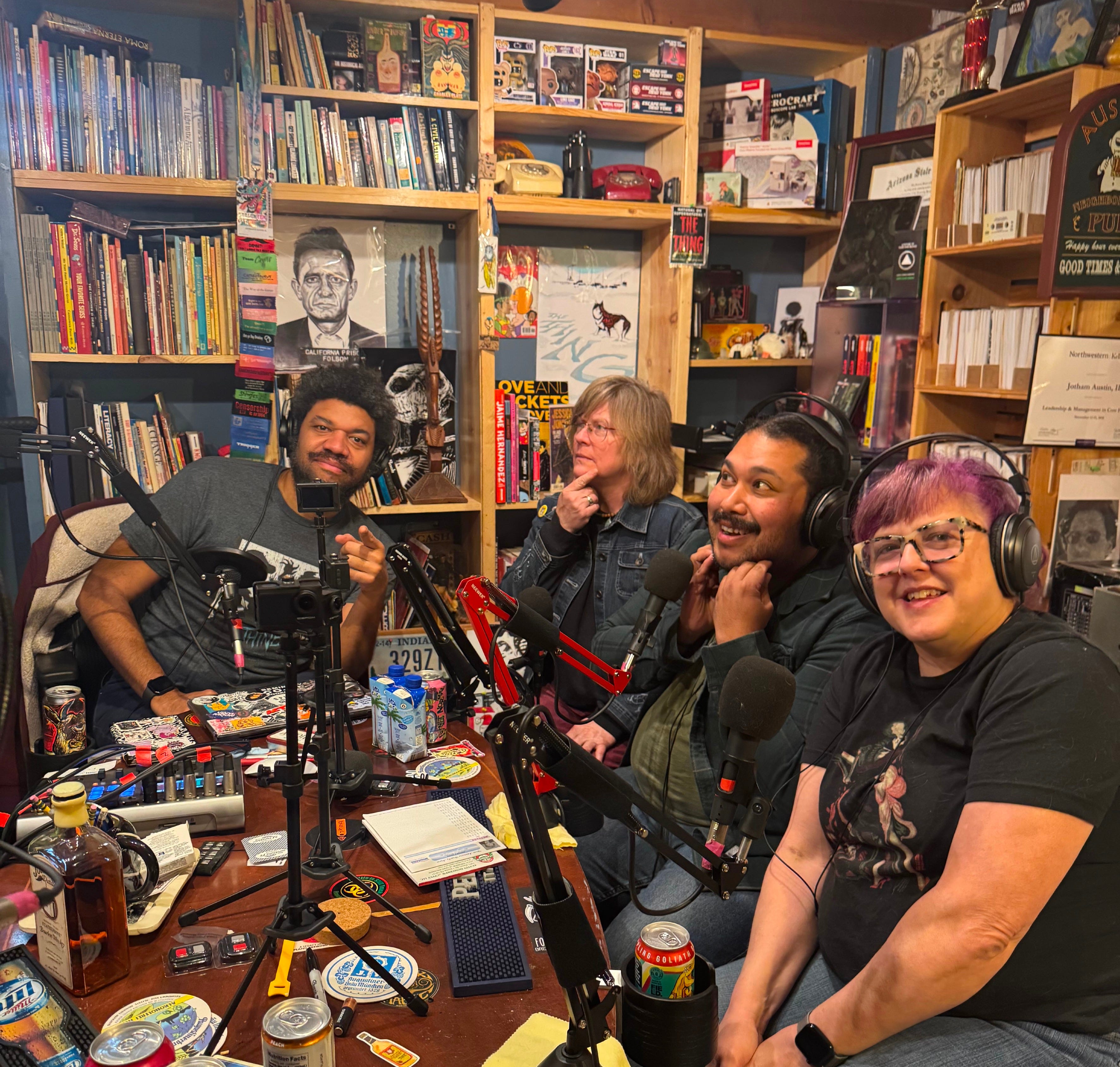


In Episode 71: The Mini, Joe, Nick, and Georgia recap Episode 70: Nazca Lines of Peru and Crop Circles featuring guest Lorena Salinas, Peruvian artist and owner of Jose’s Family Restaurant in Highland, Indiana. The crew reflects on the episode’s deeper theme, how culture shapes perspective, and how something small can change your entire relationship to a place.
Joe follows up on a comment about fireflies Nick made in a previous Mini and shares some backyard conservation tips from the Xerces Society.
Nick talks about a New York Times story about scientists connected to NASA and alien research who have gone missing or been found dead, and the crew talks through the fine line between correlation, causation, and conspiracy.
In Science Holes, Joe covers three stories: spinach-derived photosynthetic machinery used as eye drops to treat dry-eye disease, AI and large language models improving brain-computer interfaces for patients with paralysis, and a new preprint on more precise CRISPR “base editing.” This spirals into DNA sequencing, fingerprints, and how your iris is more unique.
The crew wraps with what media they are consuming, from the indie horror film Backrooms to T. Kingfisher’s Wolf Worm.
Pre-Order: Touch of Noir 2027 Wall Calendar —
12 months of all-original art by Jim and Georgia; pre-orders open now, with mailing expected in September
Joe will be at the Slay the Lake —
June 27th 3-8pm at SoundGrowler Brewery, Tinley Park, IL (This event will will benefit LGBT Books to Prisoners & Transgender Law Center)
Listen to Episode 70:

Check out what the RHR crew is creating:
Joe:
Named by the Guild Literary Complex as one of the 35 Writers to Watch!
Red Line: Chicago Horror Stories Anthology featuring a new story by Joe!
Joe’s Sci-fi physiological thriller Novel: Will You Still Love Me If I Become Someone Else?
Essay by Joe: From Beyond Press: Specific Knowledge: Jotham Austin, II, PhD on Transformations in Fiction
It’s science for Weirdos
Want to support the show? Tell your friends. Follow us on social media, Discord, share the podcast, and let us know what topics you are excited about. And to see all the content (studio images and artwork) subscribe to the Rabbit Hole of Research newsletter!
Stay curious, stay speculative, stay safe, and we’ll catch you in the next rabbit hole. Love Y'all!
Future Events to Hang with the Crew:
Podcast Cross-Appearances
The RHR crew on Ben Tanzer’s This podcast will change your life: episode three hundred seventy-nine
Events & Conventions:
Slay the Lake — June 27th event at SoundGrowler Brewery, Tinley Park, IL
Shore Leave 46 - Lancaster, PA (July 10-12, 2026)
Lancaster Wyndham Resort and Convention Center
Dragon Con - Atlanta, GA (September 3-7, 2026) - Joe attending as Professional
Upcoming Episodes
*The Mini will now be every other episode!
Three Part Spider-Man Series to get ready for the new MCU Spider-Man: Brand New Day
Episode 72 – Spider-Man Villain Series 1: Lab Safety
Guest: Tera Lavoie, PhD
The science behind Spider-Man’s rogues gallery starts here, with a deep dive into lab safety and what really happens when experiments go wrong.
Episode 74 – Spider-Man Villain Series 2: Scorpion and the Other Chimeras
Guest: Erin C. Anthony
The crew explores the science of chimeras, genetic splicing, and what it would actually take to create Spider-Man’s most dangerous foes.
Episode 76 – Spider-Man Villain Series 3: What His Villains Reveal About Him
Guest: Comic YouTuber, Alex Hanes (@Hanes4Heroes)
The conclusion of the Spider-Man trilogy takes a step back to ask what the science of his villains tells us about Spider-Man himself.
What the Crew is Digging, Links, Resources, and Topics Mentioned in mini and/or full episode:
Links & Resources:
Pre-Order: Touch of Noir 2027 Wall Calendar
12 months of all-original art by Jim and Georgia; pre-orders open now, with mailing expected in September
Firefly conservation organization; backyard practices mentioned (turn off outdoor lights, mow less/leave the leaves, reduce pesticide use)
Why Some People Think Dead and Missing Scientists Are Part of a Conspiracy New York Times article on scientists connected to NASA/alien-life research who have gone missing or been found dead, and the impact on their families
Science Holes:
1) Mouse Eyes Photosynthesize After Plant-to-Animal Transplant
Source: Nature, May 15, 2026
Researchers harvested thylakoids, the photosynthetic machinery from spinach chloroplasts, and transplanted them into the eyes of mice. The idea, inspired by sea slugs that steal chloroplasts from algae (a process called kleptoplasty), was to see if photosynthesis could help reduce inflammation in dry-eye disease, which is marked by a buildup of reactive oxygen species on the eye’s surface. The transplanted machinery (dubbed “LEAFs”) successfully soothed inflammation in mice, and researchers in China are now working toward human clinical trials.
2) China Moves AI Brain Implants from Trials Towards Real-World Use
Source: bioethics.com, citing Nature, May 2026
Over the past few years, companies, mostly in China and the United States, have added large language models to brain devices, allowing scientists to decode brain activity more accurately than older signal-processing methods. NeuroXess in Shanghai ran a trial in which a 28-year-old man with a spinal cord injury used a brain implant to control appliances by moving a cursor with his thoughts. Development of a BCI-driven smart wheelchair is in development, combining brain activity decoding with eye-tracking to direct movement.
3) An Embryo Editing “First” Is More Complicated Than Headlines Suggest
Source: Science (AAAS), referencing a bioRxiv preprint (not yet peer-reviewed)
Researchers have used base editing, a more precise version of CRISPR, that changes a single DNA “letter” without cutting both strands of the double helix, on embryos. This new process had fewer of the large chromosomal errors associated with standard CRISPR.
Science Terms
Thylakoid — the membrane structure inside chloroplasts where photosynthesis occurs; harvested from spinach for the eye drop study
Kleptoplasty — when an organism (like certain sea slugs) steals chloroplasts from another organism (like algae) and uses them for its own energy production
Reactive oxygen species — molecules that build up on the eye’s surface and trigger inflammation in dry-eye disease
Brain-computer interface (BCI) — a system that connects the brain directly to an external device, allowing brain signals to control technology
Base editing — a more precise descendant of CRISPR that changes a single DNA “letter” without creating a double-strand break, reducing the risk of large chromosomal errors
CRISPR — Clustered Regularly Interspaced Short Palindromic Repeats; a gene-editing tool adapted from a bacterial immune system that cuts and replaces DNA sequences
Preprint — a scientific paper shared publicly before completing the peer-review process
DNA structure — DNA is shaped like a twisted ladder (a double helix), made of two strands of nucleotides that wind around each other and pair up to hold the genetic code
Nucleotides (A, T, G, C) — the four chemical “letters” of DNA: adenine (A), thymine (T), guanine (G), and cytosine (C). A always pairs with T, and G always pairs with C, forming the rungs of the DNA ladder. The order of these letters provides the instructions for building proteins
DNA sequencing — the process of reading the order of A, T, G, and C letters in a piece of DNA, allowing scientists to compare genetic codes, identify mutations, and trace ancestry
Nuclear DNA — DNA stored in the cell’s nucleus; the main genetic material used in most DNA comparisons and forensics
Mitochondrial DNA — DNA found in the mitochondria, inherited only from the mother, used to trace maternal lineage
“Junk DNA” — non-coding regions of DNA that don’t produce proteins; these regions accumulate the most variation between individuals and are useful for forensic identification
Iris pattern recognition — a biometric identification method based on the unique pattern of a person’s iris, considered even more unique than fingerprints
What the Crew is Digging:
TV
Widow’s Bay (Apple TV+)— Joe, Georgia, and Nick are continuing to watch and enjoying it
Boroughs (Netflix) — Joe and Georgia finished it; liked it overall but felt it went a little off the rails at the end; noted strong commentary on aging, mortality, nursing homes, and retirement communities
Spider-Man Noir (Amazon)— Nick and Georgia still working through it; watching the black-and-white and color episodes in an alternating pattern based on a fan-made viewing order
Afterparty (Apple TV+) — Nick just started this murder mystery comedy starring Dave Franco and Ben Schwartz
Movies
Kombucha — Joe and Georgia watched it; they both appreciated the commentary on corporate versus creative life, but Joe noticed the “knee-jerk” tendency in the genre to introduce a literal physical creature rather than trusting a metaphorical one.
Backrooms — Joe saw it and highly recommends it as a must-watch, calling it a film worth revisiting multiple times; directed by a 20-year-old filmmaker named Kane Parsons, who started the project as a Blender hobby at age 14.
We Bury Our Dead — Nick watched this independent zombie film starring Daisy Ridley and felt it offered a fresh perspective on the zombie genre
Books
King of Ashes by S.A. Cosby — Joe read this Southern thriller/noir; Cosby is also writing a Marvel Luke Cage tie-in
Wolf Worm by T. Kingfisher — Joe enjoyed this novel that follows a botanist/illustrator from the late 1800s, and features flesh-eating worms/fly, including screw-worms, which have recently reemerged near the Mexico-Texas border due to federal science budget cuts.
Video Games
Horizon Zero Dawn — Nick mentions that a TV adaptation is in development.
Resident Evil: Requiem — Nick is still working through this; describes it as terrifying, in the same claustrophobic vein as the Biohazard games