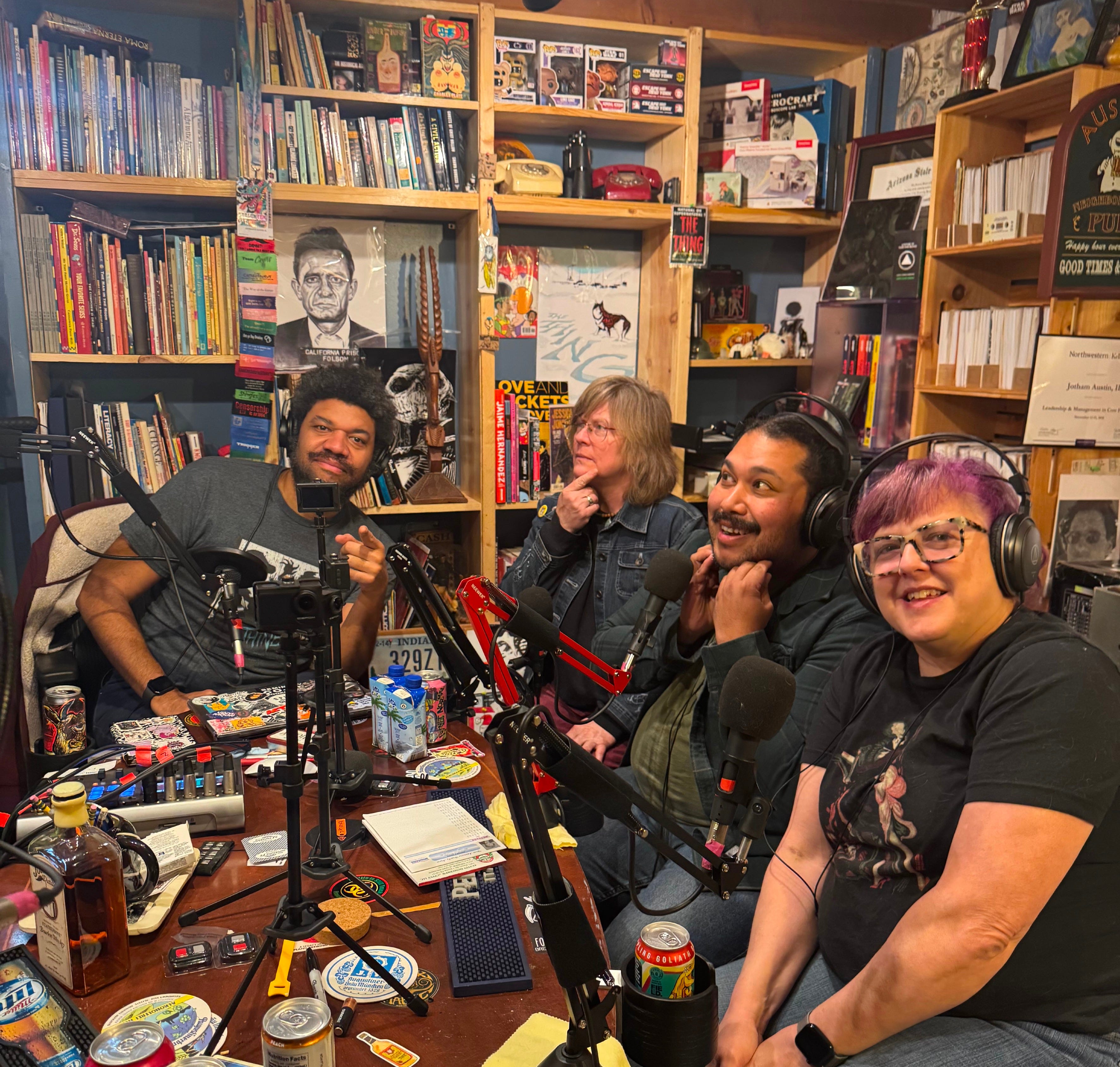


In Episode 65: “The Mini,” Joe, Nick, and Georgia recap Episode 64: Living Underground: Terrestrial and Extraterrestrial and still talking about their excitement for the Artemis II mission, which successfully flew around the Moon and back, with only a minor toilet malfunction along the way. They preview the upcoming planetary defense episode with guest Charles Blue, and break down what comes next in the Artemis program on the road back to the Moon.
Joe talks about the Catacombs of Paris, where a major renovation effort is modernizing one of the world’s most macabre tourist destinations, and the crew discusses lava tubes, moonquakes, and Georgia wonders what an atmosphere even is.
In Science Holes (the name of the current science research), Joe dives into a Stanford discovery that is challenging the foundations of molecular biology, a newly discovered bacterial defense system that breaks one of biology’s most fundamental rules. The crew connects it to CRISPR, bacteriophages, and Georgia has questions about gene editing approaches to treating sickle cell disease.
The crew closes out with what media they been consuming: For All Mankind season five, Daredevil: Born Again season two, Widow's Bay, Spaceballs, Community, the video game Phasmophobia, Free Comic Book Day at 10th Planet Comics, and books including Strange Animals, Strange Buildings, The Art Cure, Havana Hangover, and Absolution by Jeff VanderMeer. And Joe celebrates being named by the Guild Literary Complex as one of the 35 Writers to Watch!
The crew will be at the 5th Annual Mai Fest - Blue Island, IL (May 9th 12-5pm)
Joe will be one of 4 authors opening for a Blues Band: Avondalia Night Out - Rosa’s Lounge in Avondale, Chicago IL (May 14th 2026 7-8pm)- Joe reading


Listen to Episode 64:

Check out what the RHR crew is creating:
Joe:
Named by the Guild Literary Complex as one of the 35 Writers to Watch!
Red Line: Chicago Horror Stories Anthology featuring a new story by Joe!
Joe’s Sci-fi physiological thriller Novel: Will You Still Love Me If I Become Someone Else?
Essay by Joe: From Beyond Press: Specific Knowledge: Jotham Austin, II, PhD on Transformations in Fiction
It’s science for Weirdos
Want to support the show? Tell your friends. Follow us on social media, Discord, share the podcast, and let us know what topics you are excited about. And to see all the content (studio images and artwork) subscribe to the Rabbit Hole of Research newsletter!
Stay curious, stay speculative, stay safe, and we’ll catch you in the next rabbit hole. Love Y'all!
Future Events to Hang with the Crew:
Podcast Cross-Appearances
The RHR crew on Ben Tanzer’s This podcast will change your life: episode three hundred seventy-nine
Events & Conventions:
5th Annual Mai Fest - Blue Island, IL (May 9th 12-5pm)
Avondalia Night Out - Rosa’s Lounge in Avondale, Chicago IL (May 14th 2026 7-8pm)- Joe reading
Creative Arts Summit - DIY Podcast Workshop at Lake County Public Library on May 23rd, 2026
ConCarolinas - Charlotte, NC (May 29–31, 2026 ) - Joe attending as Guest
Shore Leave 46 - Lancaster, PA (July 10-12, 2026)
Lancaster Wyndham Resort and Convention Center
Dragon Con - Atlanta, GA (September 3-7, 2026) - Joe attending as Professional
Upcoming Episodes
*The Mini will now be every other episode!
Episode 66 – Planetary Defense: Saving Earth from Other Worldly Impact
Guest: Charles Blue
Exploring asteroid detection, planetary defense systems, and what it takes to protect Earth from cosmic collisions.Episode 68 - Hive Mind: Plubris
Guest: Wes Thorn (returning guest — Simulation Hypothesis episode)
The crew dives into hive minds, collective intelligence, and the blurry line between the individual and the swarm.
Three Part Spider-Man Series to get ready for the new MCU Spider-Man: Brand New Day
Episode 70 – Spider-Man Villain Series 1: Lab Safety
Guest: Tera Lavoie, PhD
The science behind Spider-Man’s rogues gallery starts here, with a deep dive into lab safety and what really happens when experiments go wrong.
Episode 72 – Spider-Man Villain Series 2: Scorpion and the Other Chimeras
Guest: Erin C. Anthony
The crew explores the science of chimeras, genetic splicing, and what it would actually take to create Spider-Man’s most dangerous foes.
Episode 74 – Spider-Man Villain Series 3: What His Villains Reveal About Him
Guest: To Be Announced
The conclusion of the Spider-Man trilogy takes a step back to ask what the science of his villains tells us about Spider-Man himself.
What the Crew is Digging, Links, Resources, and Topics Mentioned in mini and/or full episode:
Links & Resources:
Guild Literary Complex — 35 Writers to Watch — Joe named to the 2026 list
10th Planet Comics — Free Comic Book Day shoutout
Jon Parrish — comic book writer and newsletter, Northwest Indiana region
Artemis Program next steps — Artemis III targeted for 2027, crewed Orion mission docking with commercial lunar lander
Science Holes:
1) Can a Renovation Breathe New Life Into Paris’s Home for the Dead?
For more than two centuries, tourists have descended beneath the streets of Paris to visit the Catacombs — a labyrinth housing the remains of up to six million Parisians. Over the past five months, architects, designers, technicians, and masons have been renovating the vast tomb, installing new lighting and ventilation systems, restoring the bone walls, and preparing new audio guides. Some areas previously unlit will now be visible to visitors for the first time.
2) Scientists Stunned by ‘Fundamentally New Way’ Life Produces DNA
Protein-templated synthesis of dinucleotide repeat DNA by an antiphage reverse transcriptase Authors: Pujuan Deng, Hyunbin Lee, Carlo Armijo, Haoqing Wang, and Alex Gao Published: April 16, 2026
A Stanford University team discovered a bacterial enzyme, Drt3b, that synthesizes DNA using its own protein structure as a blueprint — bypassing the traditional DNA→RNA→Protein central dogma entirely. Found in a bacterial defense system called DRT3, the enzyme protects bacteria from viral infection by producing repetitive DNA sequences without a nucleic acid template. Senior author Alex Gao called it “a fundamentally new way that life produces DNA.” The discovery could have practical applications in creating customized DNA strands and advanced biomaterials like DNA hydrogels.
3) Lyfgenia — FDA-Approved Gene Therapy for Sickle Cell Disease
Source: Infectious Disease Advisor
Lyfgenia (lovotibeglogene autotemcel) is a one-time FDA-approved gene therapy from bluebird bio for sickle cell disease in patients 12 and older. Unlike CRISPR-based approaches, it uses a lentiviral vector to insert a functional modified beta-globin gene into a patient’s own stem cells, which are then reintroduced into the bone marrow to produce healthy red blood cells.
Science Terms:
Amino acids — the building blocks of proteins; humans produce 11 of the 20 needed, the rest must come from food
Atmosphere — a layer of gases surrounding a planet, held in place by gravity, that provides protection, insulation, and the ability to retain water
Autosomal recessive — a pattern of inheritance where two copies of a mutated gene are needed to cause a disorder; sickle cell anemia is autosomal recessive
Bacteriophages — viruses that infect bacteria
Central dogma of molecular biology — the standard flow of genetic information: DNA is transcribed into RNA, which is translated into protein
CRISPR — a bacterial immune defense system that recognizes and cuts viral DNA; adapted by scientists as a precision gene editing tool
DNA (Deoxyribonucleic acid) — the hereditary material in cells that carries the genetic instructions for life
DNA hydrogels — advanced biomaterials made from DNA strands; a potential application of the Drt3b discovery
Drt3b — a newly discovered bacterial enzyme that uses its own protein structure as a template to synthesize DNA, bypassing the traditional rules of base pairing
Gene therapy — a medical technique that introduces, alters, or replaces genetic material within a person’s cells to treat disease
Hemoglobin / HBB gene — the protein in red blood cells that carries oxygen; a mutation in the HBB gene causes sickle cell anemia
Lentiviral vector — a modified virus used to safely deliver new genetic material into a patient’s cells
Lyfgenia (lovotibeglogene autotemcel) — an FDA-approved one-time gene therapy for sickle cell disease that uses a lentiviral vector to insert a functional beta-globin gene into a patient’s own stem cells
Messenger RNA (mRNA) — a molecule that carries genetic instructions from DNA in the nucleus out to the ribosomes where proteins are made
Moonquakes — seismic activity on the Moon, caused by factors including tidal forces from Earth and thermal expansion; different from earthquakes in origin and intensity
Phenotype — the observable physical traits of an organism resulting from its genetic makeup and environment
Protein — large molecules made of amino acid chains that carry out most of the work in cells, including building structures, catalyzing reactions, and regulating processes
Reverse transcriptase — an enzyme that synthesizes DNA from an RNA template; used by some viruses to replicate inside host cells
Ribosome — the cellular machinery that reads mRNA and assembles proteins from amino acids
RNA (Ribonucleic acid) — a molecule involved in coding, decoding, regulation, and expression of genes; messenger RNA carries instructions from DNA to ribosomes
Sickle cell anemia — a genetic disorder caused by a mutation in the HBB gene that causes red blood cells to form rigid crescent shapes, blocking blood flow and causing pain and organ damage
Stem cells — pluripotent cells that have not yet specialized and can be coaxed to develop into many different cell types; used in the Lyfgenia therapy
Transcription — the process by which DNA is copied into messenger RNA inside the cell nucleus
Translation — the process by which ribosomes read messenger RNA and assemble a corresponding chain of amino acids to build a protein
What the Crew is Digging:
TV
For All Mankind — Season 5, Apple TV+
Daredevil: Born Again — Season 2, Disney+
Widow’s Bay — Apple TV+, just started; described as atmospheric horror comedy with Twin Peaks vibes. Joe compared it to John Carpenter’s The Fog
Community — NBC sitcom starring Joel McHale, Chevy Chase, and Alison Brie; set at a community college. Nick highly recommends it
Film
Spaceballs (1986) — Nick rewatched it and the crew loves it
Books
Strange Animals — Jared K. Anderson; Georgia gives it five stars, Nick just started it
Strange Buildings — Uketsu (anonymous Japanese YouTube creator, identity unknown — described as a real-life Banksy situation); third in a series following Strange Pictures and Strange Houses; Georgia is currently reading and recommends it
The Art Cure — Daisy Fancourt; Joe is reading — about how art can be used as medicine for mental and physical health
Havana Hangover (Book 1) — Randy Richardson; Joe is reading; second book Another Havana Hangover just released
Absolution — Jeff VanderMeer; Book 4 in the Area X series (the series that began with Annihilation); Joe is working through it slowly alongside the other two
Video Games
Phasmophobia — Nick downloaded it again ahead of a big Alan Wake 2 crossover event
Skate — Nick picked it back up