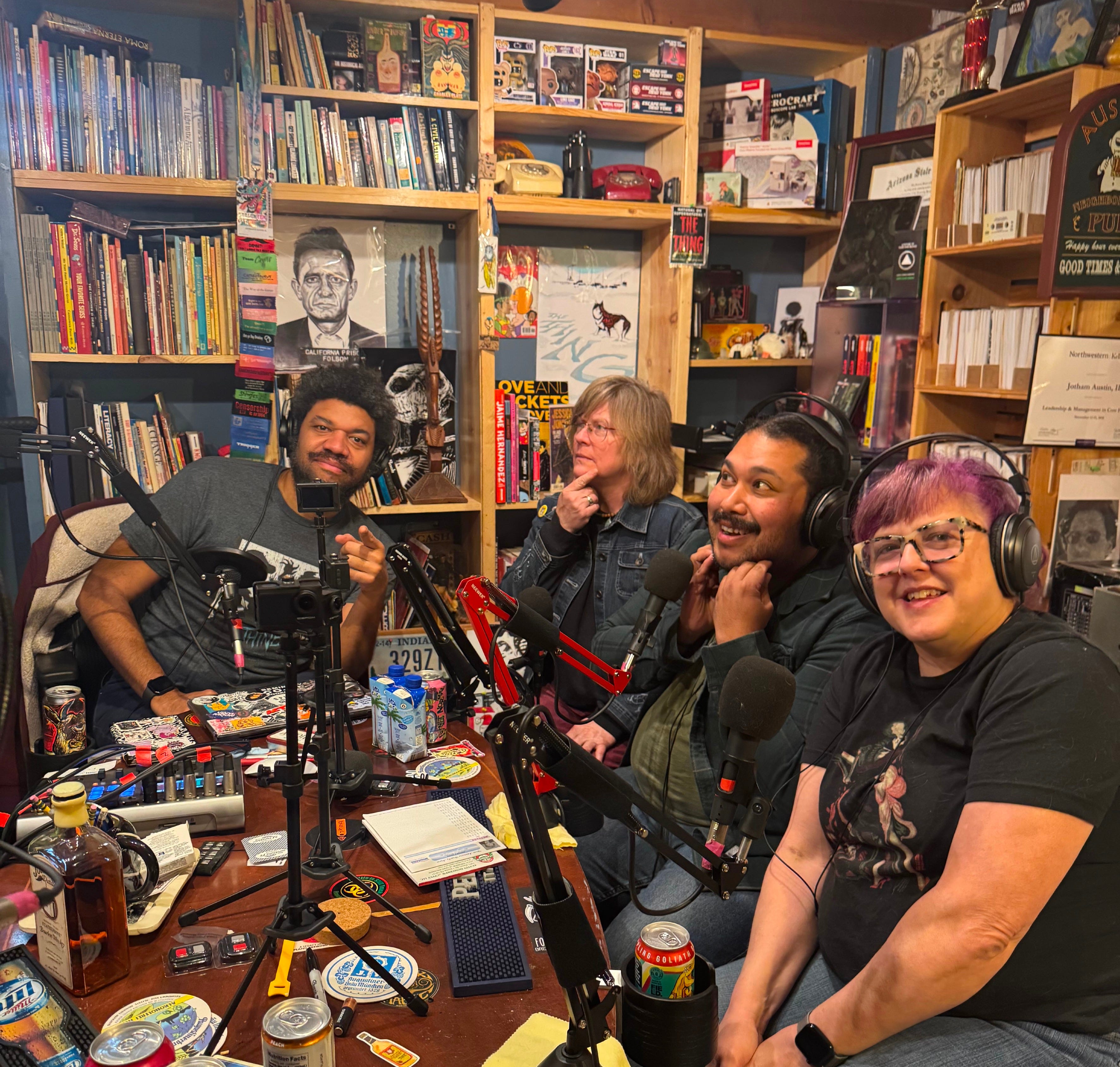


In Episode 69: The Mini, Joe, Nick, and Georgia recap Episode 68: Hive Mind featuring return guest Wes Thorn, revisiting the lively debate over individuality versus collective culture, echo chambers, and whether anyone would actually join the hive. Nick finally watched a few episodes of Plur1bus, but didn’t stay with it. Georgia talks about Alex’s Substack comment on how different cultures approach individualism versus collectivism, and his book recommendation The Hidden Life of Trees by Peter Wohlleben, in reference to the discussion on plant consciousness.
In Science Holes, Georgia follows up on the previous Mini episode on smart underwear, Nick talks about Colossal Biosciences hatching a chick from an artificially created egg as part of their de-extinction project. This leads to a conversation about CRISPR, epigenetics, and whether a genetically reconstructed animal is really the same animal that went extinct. The crew agrees they see a future gene-editing episode. Joe closes the science holes with a New York Times story and a 2024 New England Journal of Medicine study on cognitive motor dissociation; the discovery that roughly one in four seemingly unresponsive patients shows task-related brain activity on fMRI and EEG, and ties it back to the hive mind episode’s discussion of noetics and non-localized consciousness.
The crew closes out with what media they have been consuming: Boroughs on Netflix, For All Mankind, Widow’s Bay, The Mandalorian & Grogu (Have Joe say that 3 times fast), Maximum Pleasure Guaranteed on Apple TV+, and games including Borderlands 4 and Death Stranding 2. And Nick gets homework, name a hive mind video game for next time.
Listen to Episode 68:

Check out what the RHR crew is creating:
Joe:
Named by the Guild Literary Complex as one of the 35 Writers to Watch!
Red Line: Chicago Horror Stories Anthology featuring a new story by Joe!
Joe’s Sci-fi physiological thriller Novel: Will You Still Love Me If I Become Someone Else?
Essay by Joe: From Beyond Press: Specific Knowledge: Jotham Austin, II, PhD on Transformations in Fiction
It’s science for Weirdos
Want to support the show? Tell your friends. Follow us on social media, Discord, share the podcast, and let us know what topics you are excited about. And to see all the content (studio images and artwork) subscribe to the Rabbit Hole of Research newsletter!
Stay curious, stay speculative, stay safe, and we’ll catch you in the next rabbit hole. Love Y'all!
Future Events to Hang with the Crew:
Podcast Cross-Appearances
The RHR crew on Ben Tanzer’s This podcast will change your life: episode three hundred seventy-nine
Events & Conventions:
Shore Leave 46 - Lancaster, PA (July 10-12, 2026)
Lancaster Wyndham Resort and Convention Center
Dragon Con - Atlanta, GA (September 3-7, 2026) - Joe attending as Professional
Upcoming Episodes
*The Mini will now be every other episode!
Episode 70 - Nazca lines of Peru and crop circles
Guest: Lorena Salinas
The crew learns about Peruvian culture, explores ancient glyphs and touch on some alien conspiracies.
Three Part Spider-Man Series to get ready for the new MCU Spider-Man: Brand New Day
Episode 72 – Spider-Man Villain Series 1: Lab Safety
Guest: Tera Lavoie, PhD
The science behind Spider-Man’s rogues gallery starts here, with a deep dive into lab safety and what really happens when experiments go wrong.
Episode 74 – Spider-Man Villain Series 2: Scorpion and the Other Chimeras
Guest: Erin C. Anthony
The crew explores the science of chimeras, genetic splicing, and what it would actually take to create Spider-Man’s most dangerous foes.
Episode 76 – Spider-Man Villain Series 3: What His Villains Reveal About Him
Guest: Comic YouTuber, Alex Hanes (@Hanes4Heroes)
The conclusion of the Spider-Man trilogy takes a step back to ask what the science of his villains tells us about Spider-Man himself.
What the Crew is Digging, Links, Resources, and Topics Mentioned in mini and/or full episode:
Links & Resources:
The Hidden Life of Trees: What They Feel, How They Communicate: Discoveries from a Secret World — recommended by listener Alex.
Vegetative Patients May Be More Aware Than We Knew — New York Times article discussed by Joe.
Cognitive Motor Dissociation in Disorders of Consciousness — New England Journal of Medicine, 2024.
Colossal Biosciences — de-extinction science company behind the dire wolf and artificial egg projects.
Science Holes:
1) Follow-up from a previous Mini on Smart Underwear: Fart filters
Buck Weimer, an inventor, whose wife had Crohn’s disease, which led her to have high flatulence, and tension in their marriage. After years of research, he perfected and patented the design for Under-Ease, flatulence-filtering underwear.
2) Colossal Biosciences — De-Extinction and the Artificial Egg Project
The company behind the dire wolf de-extinction project, has hatched a chick using an artificially created egg as part of their ongoing de-extinction work. The bird is believed to be the moa, a giant extinct bird from New Zealand hunted to extinction by the Māori people approximately 500-600 years ago. The crew debated whether a genetically reconstructed animal is truly the same species that went extinct, diving into epigenetics, environmental adaptation, and the Ship of Theseus problem. Nick raised the question of habitat and environmental adaptation; what happens to a resurrected animal in a world completely different from the one it evolved in? Look forward to a future episode on CRISPR and gene editing.
3) Vegetative Patients May Be More Aware Than We Knew
The New York Times story following a woman whose husband fell into a vegetative state after a diabetic coma. After reading about cognitive motor dissociation, she questioned whether everything possible had been done to test his consciousness. The story raises difficult questions about how vegetative patients are labeled, treated, and monitored once transferred to nursing homes.
Cognitive Motor Dissociation in Disorders of Consciousness Authors: Yelena G. Bodien, Ph.D., et al. Published: August 14, 2024 New England Journal of Medicine 2024;391:598-608
Patients with brain injury who are unresponsive to commands may still perform cognitive tasks detectable on fMRI and EEG, a phenomenon known as cognitive motor dissociation. In a large cohort study, approximately one in four participants without any observable response to commands showed task-related brain activity on fMRI or EEG. The findings raises questions about how we define and measure consciousness, who gets further treatment, and whether seemingly unresponsive patients may still be internally aware.
Science Terms
Cognitive motor dissociation — a phenomenon where patients with brain injury who appear unresponsive to commands still show task-related brain activity detectable on fMRI or EEG, suggesting hidden awareness
Coma — a state of prolonged unconsciousness in which a patient cannot be awakened and does not respond to stimuli; different from a vegetative state in that coma patients show no sleep-wake cycles
CRISPR — a bacterial immune defense system adapted by scientists as a precision gene editing tool, used in de-extinction projects to modify the genome of living species with genetic material from extinct ones
De-extinction — the process of using genetic engineering and reproductive technology to resurrect species that have gone extinct, pioneered by companies like Colossal Biosciences
EEG (Electroencephalography) — the measurement and recording of electrical activity in different parts of the brain, used to detect signs of consciousness in unresponsive patients
Epigenetics — the study of how environmental factors turn genes on and off without changing the underlying DNA sequence, raising questions about whether a de-extinct animal would truly behave like its ancestor
fMRI (Functional Magnetic Resonance Imaging) — a brain imaging technique that measures small changes in blood flow to detect brain activity, used to identify hidden consciousness in vegetative patients
Non-localized consciousness — the concept explored in noetics that consciousness is not strictly contained within the brain but may exist beyond it, potentially still accessible in patients with disorders of consciousness
Noetics — the study of consciousness as a phenomenon that cannot be fully explained by brain activity alone, exploring whether the mind has properties beyond what neuroscience currently accounts for
Vegetative state — a condition in which a patient is awake but shows no signs of awareness or response to commands, now being reexamined in light of cognitive motor dissociation research
What the Crew is Digging:
TV
Boroughs — Netflix; Duffer Brothers new series; Joe and Georgia are about halfway through and reminds them of Cocoon
For All Mankind — Apple TV+; Joe and Georgia are waiting for the season finale to drop
Widow’s Bay — Apple TV+; Joe, Georgia, and Nick are all watching
The Mandalorian & Grogu — Joe and Georgia saw it in theaters; described as action-packed, John Wick in space; Georgia warns: Pedro Pascal is in his helmet for almost the entire film
Maximum Pleasure Guaranteed — Apple TV+; Nick recommends it; three episodes in; stars Tatiana Maslany (from She-Hulk); described as a mystery thriller
Movies
Cocoon (1985) — referenced by Joe and Georgia as an influence on Burrows; alien fountain of youth story; hard to find streaming, may require a library trip
Batteries Not Included (1987) — Georgia referenced it in the same breath as Cocoon and E.T. as part of that era of alien films
Mac and Me (1988) — Nick enthusiastically recommends it; Joe enthusiastically does not
Video Games
Borderlands 4 — Nick just started playing
Death Stranding 2 — Nick just picked it up; by Hideo Kojima; described as “really weird” with nothing but good things heard about it
Nick’s homework — name a hive mind video game for next episode