

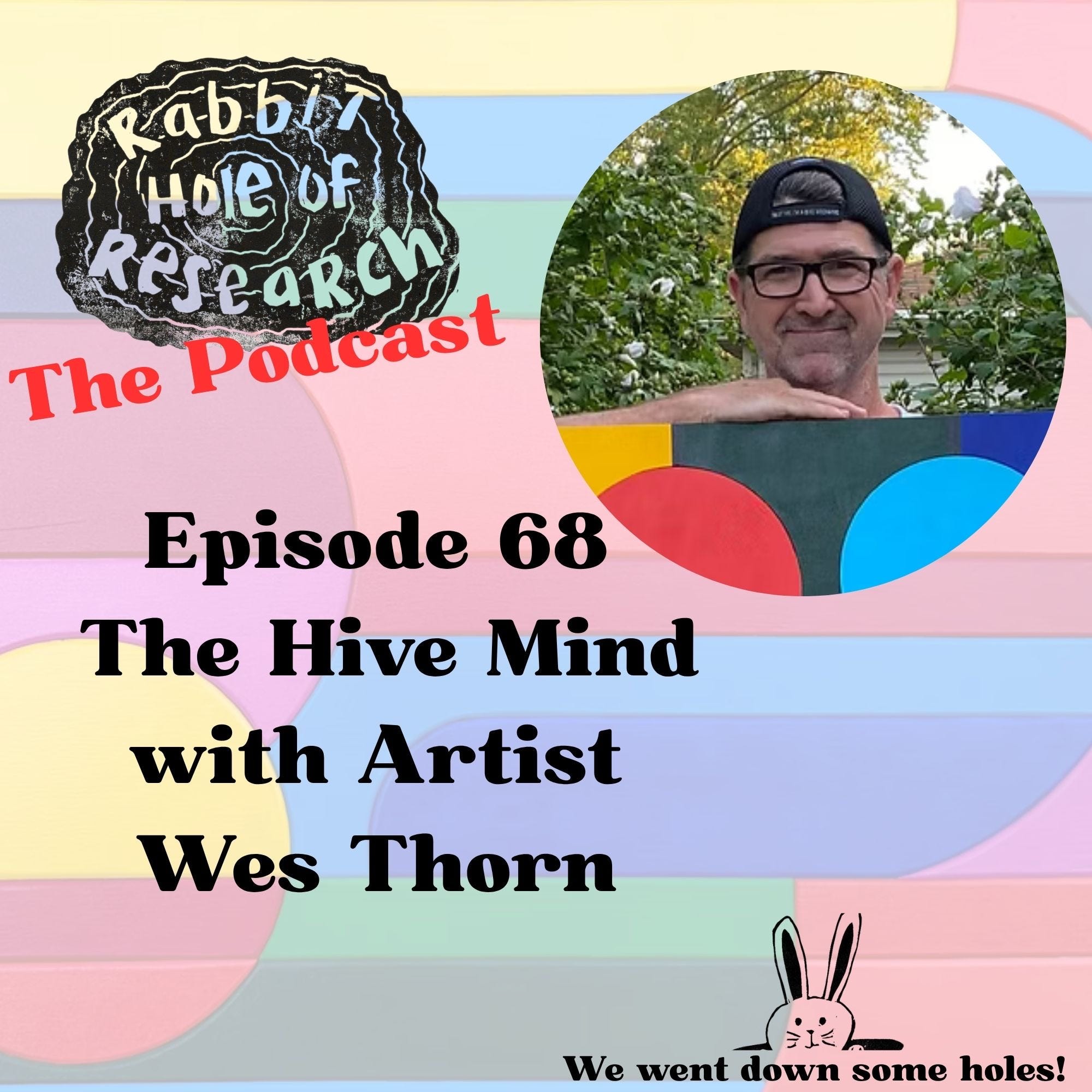
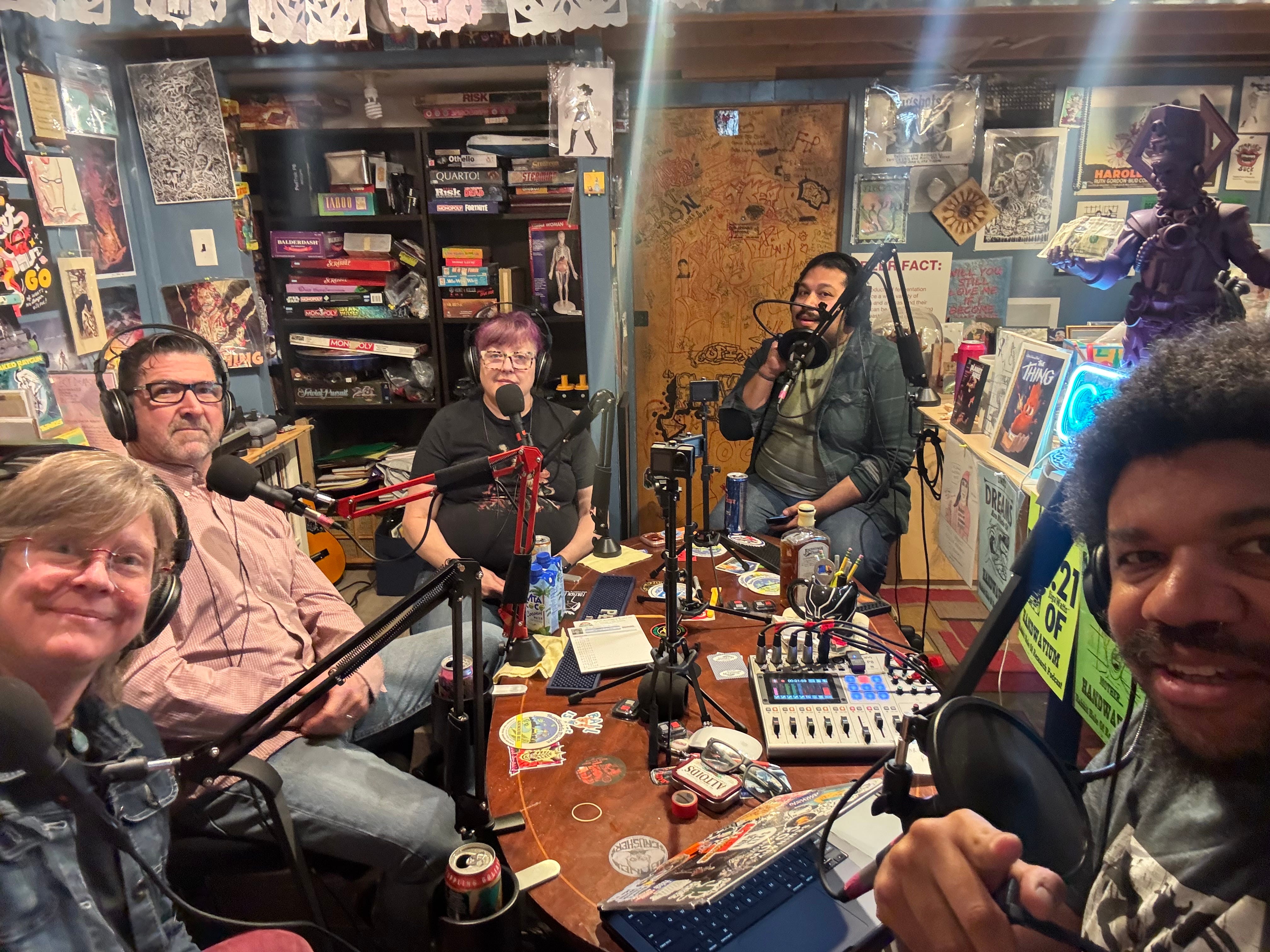
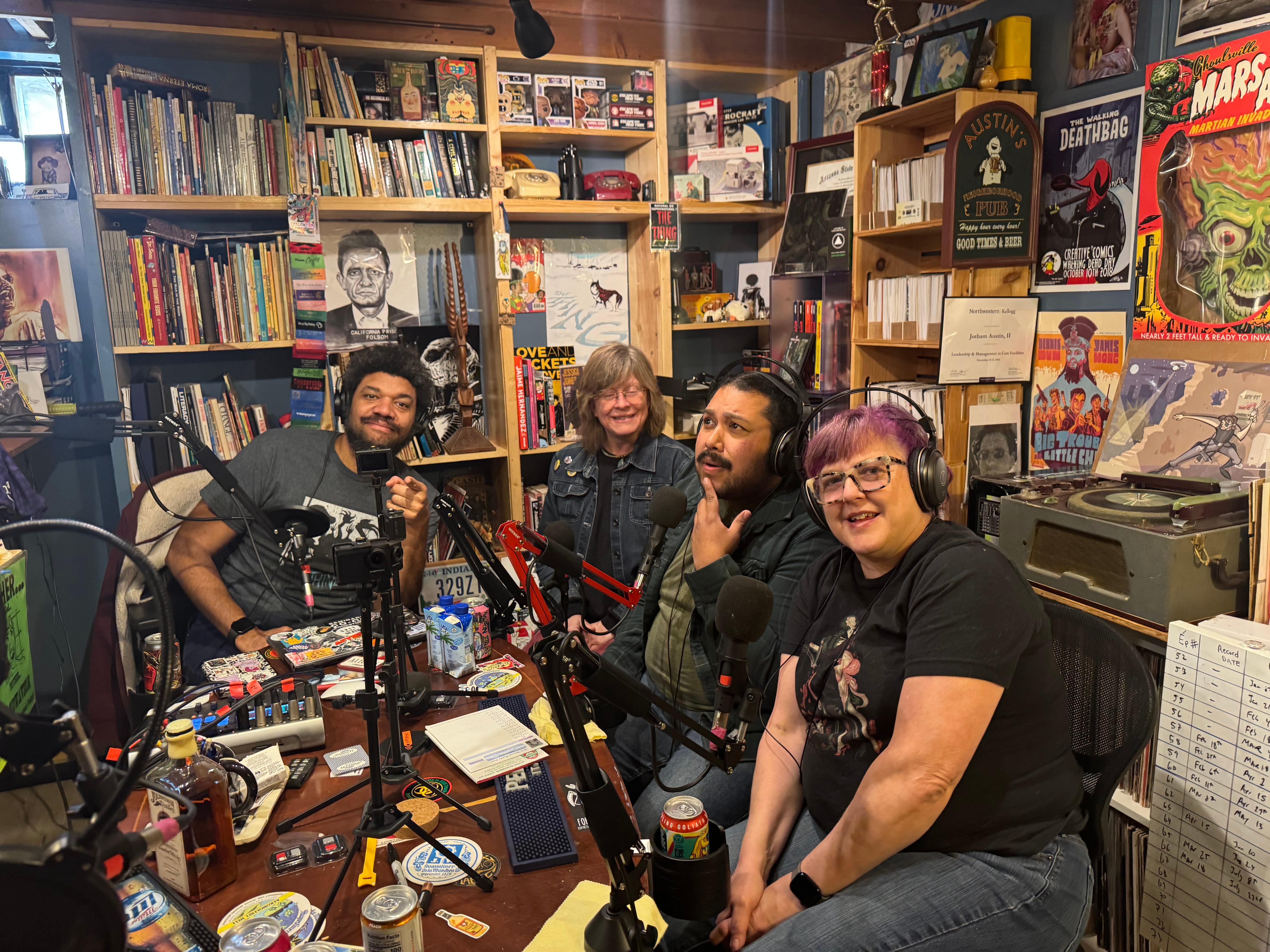
In the 68th episode of Rabbit Hole of Research, from the Basement Studio, Joe, Nick, Georgia, Mary, and returning guest Wes Thorn (last seen defending the Simulation Hypothesis in Episode 26) dive into one of science fiction’s most unsettling concepts: the hive mind.
It starts with a simple question: is the private voice inside your skull really yours? From there the crew tumbles down the rabbit hole of collective consciousness, exploring nature’s original hive minds, bees, ants, slime molds, and the 80,000-year-old aspen grove that is technically one single organism, before asking what science actually knows about consciousness itself. Spoiler: not much. There are 29 competing theories and counting, and researchers still can’t agree on a definition.
The crew discusses Apple TV+’s new show Plur1bus, (no spoilers) a show about an alien signal decoded as a genetic blueprint that folds humanity into a single collective consciousness. The crew debates individuality vs. collective good, whether a true hive mind can have a leader (Nick is unconvinced), the Borg’s mythology-breaking queen problem, and what separates a hive mind from a cult.
Along the way they get into noetics and non-local consciousness, acquired savant syndrome, yoga philosophy’s concepts, the complexities of fungal networks, and whether the internet is already a proto-hive mind or just a very loud echo chamber.
And at the end, everyone has to answer the question: would you join?
Come see Joe on several panels at ConCarolinas - Charlotte, NC (May 29–31, 2026 )
Check out what the RHR crew is creating:
Joe:
Named by the Guild Literary Complex as one of the 35 Writers to Watch!
Red Line: Chicago Horror Stories Anthology featuring a story by Joe!
Joe’s Sci-fi physiological thriller Novel: Will You Still Love Me If I Become Someone Else?
Joe’s Rom-Com Novella: Tomorrow May Be Too Late
Essay by Joe: From Beyond Press: Specific Knowledge: Jotham Austin, II, PhD on Transformations in Fiction
Future Events to Hang with the Crew:
Podcast Cross-Appearances
Joe on GoIndieNow: 21grams with Joe Compton talking about villains.
RHR Crew on This Podcast Will Change Your Life with Ben Tanzer
Events & Conventions:
ConCarolinas - Charlotte, NC (May 29–31, 2026 ) - Joe attending as Guest
Slay the Lake Chicago Pride Book Fest Soundgrowler Brewing Co., Tinley Park, IL 60487 (June 27, 2026 12PM-5PM)
Shore Leave 46 - Lancaster, PA (July 10-12, 2026)
Lancaster Wyndham Resort and Convention Center
Dragon Con - Atlanta, GA (September 3-7, 2026) - Joe attending as Professional
It’s Science for Weirdos
Want to support the show? Tell your friends. Follow us on social media, Discord, share the podcast, and let us know what topics you are excited about. Leave a Comment. And for email alerts sign-up for the Substack newsletter and never miss an episode, exciting updates or the bonus images we talk about on the episodes.
We want to Hear From You (leave a comment):
Joe, Georgia, Mary, Wes, and Nick all gave their answer at the end, would you join the hive? What would it take to change your answer?
The episode draws a line between a cult and a true hive mind. A cult has a leader with a motive, a hive mind has neither. Do you buy that distinction, or like Nick, feel that it’s a technicality?
Mary brought up concepts from yoga philosophy, the idea that the “you” you think of as yours is actually a collective of everything that came before you. Does that make the idea of a hive mind less scary or more?
Drop your thoughts in the comments. We read them all, and your ideas often shape future episodes.
Future Episodes
Episode 70 - Nazca lines of Peru and crop circles
Guest: Lorena Salinas
The crew learns about Peruvian culture, explores ancient glyphs and touch on some alien conspiracies.
Three Part Spider-Man Series to get ready for the new MCU Spider-Man: Brand New Day
Episode 72 – Spider-Man Villain Series 1: Lab Safety
Guest: Tera Lavoie, PhD
The science behind Spider-Man’s rogues gallery starts here, with a deep dive into lab safety and what really happens when experiments go wrong.
Episode 74 – Spider-Man Villain Series 2: Scorpion and the Other Chimeras
Guest: Erin C. Anthony
The crew explores the science of chimeras, genetic splicing, and what it would actually take to create Spider-Man’s most dangerous foes.
Episode 76 – Spider-Man Villain Series 3: What His Villains Reveal About Him
Guest: Comic YouTuber, Alex Hanes (@Hanes4Heroes)
The conclusion of the Spider-Man trilogy takes a step back to ask what the science of his villains tells us about Spider-Man himself.
For more stuff (Images, Episode Highlights, events, etc), subscribe to our Substack newsletter!
Show Notes & Fun facts
Slime Mold Images & Further Reading:
The Unexpected Beauty of Dog Vomit and Other Slime — New York Times
Episodes Mentioned
Books mentioned:
Lose Your Mind — Josh Pais
Honeybee Democracy — Thomas Seeley
The Wisdom of Crowds — James Surowiecki
More Than Human — Theodore Sturgeon
Last and First Men — Olaf Stapledon
The Midwich Cuckoos — John Wyndham
Starship Troopers — Robert Heinlein
The First Men in the Moon — H.G. Wells
Films and TV mentioned:
Plur1bus — (2026) Apple TV+
The Thing (1982) — John Carpenter
The Stuff (1985)
Invasion of the Body Snatchers (1978)
Village of the Damned (1960)
Annihilation (movie 2018); Jeff VanderMeer (novel 2014)
The Matrix (1999)
Avatar — James Cameron (2009)
Army of Darkness —Sam Raimi (1993)
Severance — Apple TV+
The Last of Us (2023—)
Mystery Science Theater 3000 — The Deadly Bees episode
Wonderman —Disney+ (2026)
Video Games mentioned:
none in this episode. Come on Nick! LOL
Fun Facts to Impress Your Friends With:
Your brain is telling you a story, slightly after the fact. The “you” that feels like a unified self making conscious decisions is actually a narrative your brain constructs after the neurons have already fired. You don’t decide and then act, you act, and then your brain tells you that you decided. Neuroscientist Anil Seth calls conscious experience a “controlled hallucination.”
A single grove of trees in Utah is actually one organism. Pando, a grove of quaking aspen in Utah, is made up of 47,000 tree trunks that share a single root system. It is estimated to be 80,000 years old, making it one of the oldest living things on Earth, and it has no brain, no nervous system, and no central command. It is also currently dying due to human activity.
Slime mold designed a better subway system than engineers did. Researchers placed food sources on a map of Tokyo at the locations of major train stations, then released slime mold. With no brain, no nervous system, and no blueprint, the slime mold grew a network nearly identical to the actual Tokyo rail system, surprisingly finding the most efficient routes through pure chemical signaling.
There are 29 competing scientific theories of consciousness, and none of them fully work. A 2026 Scientific American feature surveyed research published over a decade and found 29 distinct theories of consciousness. The three most published are Global Workspace Theory, Integrated Information Theory, and quantum theories. Researchers can’t even agree on a definition, let alone a solution.
A traumatic brain injury can unlock abilities you never learned. Acquired savant syndrome is a real and documented phenomenon. Derek Amato hit his head in a swimming pool accident and woke up able to play piano at concert level, seeing the music as black and white squares. Jason Padgett was mugged, hit his head, and woke up seeing the world in fractals, he became a mathematical savant despite having no mathematical background. The leading explanation is disinhibition, the injury turns off the brain’s filtering system, allowing access to processing that was always happening below conscious awareness.
Some scientists think consciousness isn’t in your brain at all. Noetics is the study of consciousness as something that can’t be fully explained by brain activity alone. The Institute of Noetic Sciences, founded by Apollo 14 astronaut Edgar Mitchell after his overview effect experience on the moon, researches near-death experiences, mind-body healing, and intuition. The idea of non-local consciousness, that your mind exists beyond your skull, like music stored in a cloud you tune into rather than generate is controversial, but it’s the one framework where a hive mind wouldn’t require any new technology at all. Just a different understanding of what consciousness already is.
Episode Highlights
00:00 Basement Studio Roll Call — Joe, Nick, Georgia, Mary, and returning guest Wes Thorn (Simulation Hypothesis, Episode 26) are all crewed up in the Basement Studio.
01:09 Hive Mind Cold Open — Joe sets the mood asking whether the private voice inside your skull is really yours, and whether you’d even know if you were already part of a hive mind.
03:17 Simulation Hypothesis Update — Wes reveals he has softened his stance on the simulation hypothesis since Episode 26 — “I have my doubts.”
04:46 Nature Hive Minds — The crew digs into bees, ants, pheromone trails, waggle dances, and whether coordinated behavior is the same thing as shared consciousness.
09:06 Plur1bus Explained — Wes breaks down the premise: an alien signal from Kepler-22, decoded as a genetic blueprint, folds humanity into a single collective consciousness with a directive to retransmit.
10:53 Join or Resist Debate — The crew debates whether losing individuality to the hive is transcendence or horror — and whether creativity survives the merger.
12:25 Borg and Cult Comparisons — Joe draws the line between a cult (hierarchy, leader, motive) and a true hive mind (no leader, no scarcity, no competitive edge) — “there is no Jim Jones in the hive.”
17:58 Internet Echo Chambers — Georgia argues the internet already feels like a hive mind; Nick pushes back that it’s more echo chamber than collective consciousness.
21:49 Escaping Big Tech — Mary explains her effort to starve the beast by switching to Ecosia, deleting the YouTube app, and watching without ads — sparking a broader conversation about algorithmic control.
24:22 Studying Consciousness — Joe brings it back to the science: 29 competing theories, no agreed definition, and the fundamental problem of trying to study consciousness using the only tool you have — your own consciousness.
27:55 Noetics and Savants — Wes introduces non-local consciousness; Joe follows with acquired savant syndrome; Derek Amato, Orlando Serrell, and Jason Padgett — and the idea that the brain may be a filter, not a generator.
32:10 Yoga and Inner Layers — Mary brings in yoga philosophy’s model of the body as layers, and the concept of No Self, teasing out what is permanent from what is just passing thought.
35:54 Plants and Fungal Networks — Joe explains the Wood Wide Web, mycelial networks, and Pando, the 80,000-year-old aspen grove that is technically one single organism.
38:05 Plur1bus Ethics and Food — The crew debates what the joined humans will and won’t eat, and whether the hive’s environmental consciousness is the real motivation behind the signal.
39:20 Opting Out of Plur1bus — Nick asks if you can opt out; the crew explains the 13 immune individuals including Carol, the show’s main protagonist, The crew agrees looks like Mary.
40:30 Fungal Hive Networks — Joe tries to science the Plur1bus model, a tuner that allows everyone to focus on the same signal from the collective cloud.
42:28 Slime Mold Intelligence — Joe explains how slime mold with no brain, no neurons, and no command center recreated the Tokyo rail system using pure chemical signaling.
45:04 AI and Collective Minds — Wes draws a parallel between hive minds and AI, both are collective intelligence without individual authorship, and Joe pushes back on calling predictive text “intelligence.”
46:21 Autonomy and Colonization — Nick connects the horror of losing autonomy to colonization, taking over personality, views, and culture under the guise of knowing better, “basically calling them savages.”
50:58 Cults vs True Hive Minds — Mary argues a cult is a hierarchy not a hive; the crew lands on the key distinction: a true hive has no leader, no agenda, and no economic friction.
57:32 No Self and Collective Power — Mary makes the case that the self is already a collective of everything that came before us, and that authoritarians throughout history have banned group gatherings precisely because of the strength in numbers.
01:00:26 Hive Mind in Fiction History — Joe runs through the timeline from H.G. Wells (1901) to Plur1bus, hitting the Borg, The Thing, The Stuff, Invasion of the Body Snatchers, and the first use of the phrase “hive mind” in 1950.
01:05:00 Cowboy Culture and Fear — Mary and Joe dig into why American culture breeds suspicion of collective thinking, “we don’t aspire to be together, we aspire to be the cowboy.”
01:07:57 Final Thoughts and Would You Join — The crew gives their verdicts: Nick is a hard no, Wes wants a 72-hour trial, Georgia is leaning no today, Mary would have questions, and Joe, wants to be king.
01:16:36 Wrap Up and Thanks — The crew thanks Wes, reminds listeners to reach out, and:
“Stay curious, stay safe… Love Y’all!”
Join Rabbit Hole of Research on Discord: https://discord.gg/2nnmKgguFV
Subscribe and Share our Substack newsletter to get email updates, never miss an episode, and spread the word!! Don’t forget to give us 5 stars or a like!