

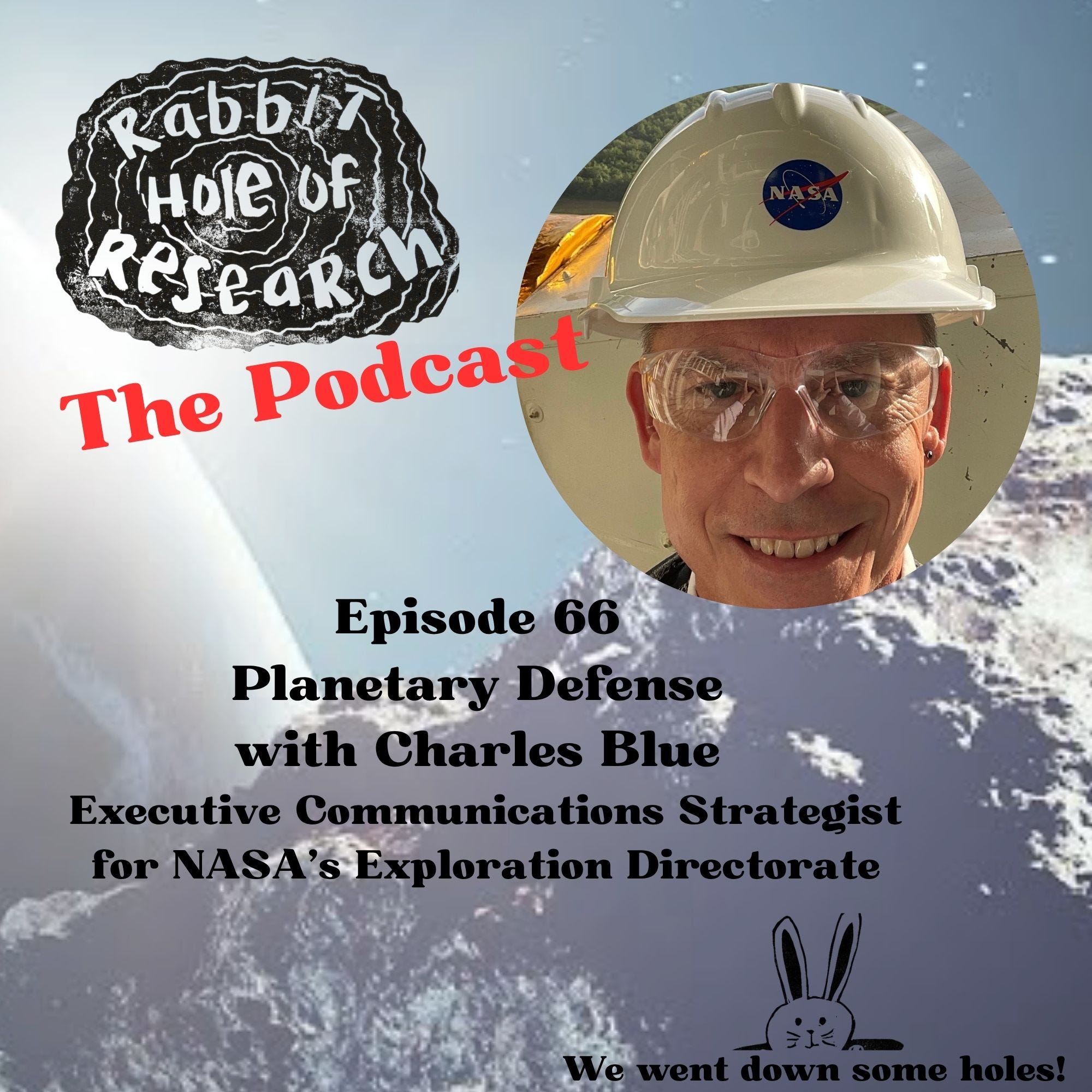
In Episode 66 of Rabbit Hole of Research, Joe, Nick, Georgia, and Mary welcome Charles Blue, a science writer with over 35 years of experience in astronomy, Earth science, and science communications. Charles serves as Executive Communications Strategist for NASA’s Exploration Directorate, and has participated in tabletop exercises that simulate real government responses to potentially hazardous near-Earth objects (NEOs).
The crew digs into the difference between asteroids, comets, and NEOs, why objects approaching from the sun’s direction are nearly impossible to detect, and how impact risk changes dramatically depending on size, composition, and warning time. Charles walks through the global network of observatories tracking these threats, the communication challenges of telling the public something might be coming, and what those tabletop scenarios actually look like when the cone of uncertainty lands on the place he calls home.
From altering an asteroid's albedo, its surface reflectivity, with paint, to kinetic impactors to the politics of nuclear deflection, the crew works through what we can actually do, and how NASA’s DART mission proved that moving an asteroid isn’t just Handwavium. Charles also discusses next-generation detection, and Joe asks about the dangers of asteroid mining liability, and pulls on the Starship Troopers conspiracy thread.
The real science of planetary defense is more interesting than anything Hollywood has thrown at us.
And yes, we’re looking at you Armageddon.
About Charles:
Charles is a science writer specializing in astronomy and Earth science. He has more than 35 years of strategic communications experience in science, engineering, and technology.
Charles currently serves as Executives Communications Strategist for NASA’s exploration directorate. He also served as the Writer/Editor for the National Science Foundation’s Directorate for Engineering and as public information officer for the National Radio Astronomy Observatory.
When not getting himself and others worked up about science, you’ll find him playing the Irish tenor banjo, haunting social media, exploring Colonial Williamsburg, and singing sea chanteys.
Link to Charles Blue’s Bluesky: https://bsky.app/profile/science-dude.bsky.social
Link to First Light Con: www.firstlightcon.com
Joe will be one of 4 authors opening for a Blues Band: Avondalia Night Out - Rosa’s Lounge in Avondale, Chicago IL (May 14th 2026 7-8pm)- Joe reading
Check out what the RHR crew is creating:
Joe:
Named by the Guild Literary Complex as one of the 35 Writers to Watch!
Red Line: Chicago Horror Stories Anthology featuring a story by Joe!
Joe’s Sci-fi physiological thriller Novel: Will You Still Love Me If I Become Someone Else?
Joe’s Rom-Com Novella: Tomorrow May Be Too Late
Essay by Joe: From Beyond Press: Specific Knowledge: Jotham Austin, II, PhD on Transformations in Fiction
Future Events to Hang with the Crew:
Podcast Cross-Appearances
Joe on GoIndieNow: 21grams with Joe Compton talking about villains.
RHR Crew on This Podcast Will Change Your Life with Ben Tanzer
Events & Conventions:
Avondalia Night Out - Rosa’s Lounge in Avondale, Chicago IL (May 14th 2026 7-8pm)- Joe reading
Creative Arts Summit - DIY Podcast Workshop at Lake County Public Library (Merrillville, IN) on May 23rd, 2026
ConCarolinas - Charlotte, NC (May 29–31, 2026 ) - Joe attending as Guest
Slay the Lake Chicago Pride Book Fest Soundgrowler Brewing Co., Tinley Park, IL 60487 (June 27, 2026 12PM-5PM)
Shore Leave 46 - Lancaster, PA (July 10-12, 2026)
Lancaster Wyndham Resort and Convention Center
Dragon Con - Atlanta, GA (September 3-7, 2026) - Joe attending as Professional
It’s Science for Weirdos
Want to support the show? Tell your friends. Follow us on social media, Discord, share the podcast, and let us know what topics you are excited about. Leave a Comment. And for email alerts sign-up for the Substack newsletter and never miss an episode, exciting updates or the bonus images we talk about on the episodes.
We want to Hear From You (leave a comment):
If you knew an asteroid was on a collision course with Earth, would you want the government to tell you? Or would you rather not know?
DART proved we can move an asteroid, but who should have the authority to make that call? One country, the UN, everyone?
What’s your favorite fictional take on an asteroid or comet impact, and don’t worry about the science, they all use a healthy dose of Handwavium?
The Starship Troopers conspiracy, did the government let Buenos Aires happen? We want to know where you stand.
Drop your thoughts in the comments. We read them all, and your ideas often shape future episodes.
Future Episodes
Episode 68 - Hive Mind: Plubris
Guest: Wes Thorn (returning guest — Simulation Hypothesis episode)
The crew dives into hive minds, collective intelligence, and the blurry line between the individual and the swarm.
Three Part Spider-Man Series to get ready for the new MCU Spider-Man: Brand New Day
Episode 70 – Spider-Man Villain Series 1: Lab Safety
Guest: Tera Lavoie, PhD
The science behind Spider-Man’s rogues gallery starts here, with a deep dive into lab safety and what really happens when experiments go wrong.
Episode 72 – Spider-Man Villain Series 2: Scorpion and the Other Chimeras
Guest: Erin C. Anthony
The crew explores the science of chimeras, genetic splicing, and what it would actually take to create Spider-Man’s most dangerous foes.
Episode 74 – Spider-Man Villain Series 3: What His Villains Reveal About Him
Guest: Comic YouTuber, Alex Hanes (@Hanes4Heroes)
The conclusion of the Spider-Man trilogy takes a step back to ask what the science of his villains tells us about Spider-Man himself.
For more stuff (Images, Episode Highlights, events, etc), subscribe to our Substack newsletter!
Show Notes & Fun facts
Link to the Vera Rubin Observatory data portal
NASA Planetary Defense Coordination Office — https://science.nasa.gov/planetary-defense/
NASA DART Mission — https://science.nasa.gov/planetary-defense-dart/
ESA Hera Mission — https://www.esa.int/Space_Safety/Hera
NASA NEO Surveyor Mission — https://science.nasa.gov/mission/neo-surveyor/
NASA OSIRIS-REx / Bennu Sample Return — https://science.nasa.gov/mission/osiris-rex/
NASA Psyche Mission — https://science.nasa.gov/mission/psyche/
Vera Rubin Observatory — https://rubinobservatory.org/
NASA Eyes on Asteroids (interactive real-time tracker) — https://eyes.nasa.gov/apps/asteroids/
Link to Charles Blue’s Bluesky: https://bsky.app/profile/science-dude.bsky.social
Link to First Light Con: www.firstlightcon.com
Books mentioned:
Lucifer’s Hammer — Larry Niven and Jerry Pournelle
Footfall — Larry Niven and Jerry Pournelle
The Hammer of God — Arthur C. Clarke
The Conversation of Eiros and Charmion — Edgar Allan Poe
The Comet — Oliver Wendell Holmes Sr.
La Fin du Monde (Omega: The Last Days of the World) — Camille Flammarion
The Star — H.G. Wells
The Comet — W.E.B. Du Bois
When Worlds Collide — Philip Wylie and Edwin Balmer
Films and TV mentioned:
Armageddon (1998)
Deep Impact (1998)
Don’t Look Up (2021)
Moonfall (2022)
Meteor (1979)
Starship Troopers (1997)
Seeking a Friend for the End of the World (2012)
Greenland (2020)
Melancholia (2011)
Salvation (CBS, 2017-2018)
The Thing (1982)
For All Mankind (TV series)
Cosmos (Carl Sagan, 1980)
Cosmos (Neil deGrasse Tyson reboot)
Video Games mentioned:
Asteroids (Atari, 1979)
Planetary Annihilation (2016)
Fun Facts to Impress Your Friends With:
The asteroid that killed the dinosaurs hit the worst possible spot, or best spot for us humans: If the Chicxulub impactor had struck open ocean or solid land, the dinosaurs might have survived. But, it hit a shallow limestone shelf off the Yucatan Peninsula, vaporizing millions of tons of sulfur-rich rock and pumping toxic chemicals into the atmosphere. Five seconds later in Earth’s rotation and Velociraptors might still be running around Chicago.
DART changed an asteroid’s orbit NASA’s DART spacecraft didn’t just push Dimorphos, it triggered a massive ejecta plume that acted like a thruster, amplifying the push far beyond what the impact alone could deliver. The mission needed to change the orbital period by 73 seconds to be considered a success. It changed it by 33 minutes.
The Chelyabinsk meteor injured 1,500 people and nobody saw it coming In 2013 a 20-meter asteroid exploded over Russia. Most injuries came from people rushing to the window to see the flash, just before the shockwave hit. Lesson: if you see a bright flash in the sky, get away from the windows.
Painting asteroids is a proposed, low-cost planetary defense method It involves altering an asteroid's albedo—its surface reflectivity—to change its orbit via the Yarkovsky effect. By coating an asteroid with a highly reflective material like white paint or alkali metal, solar radiation pressure increases, creating a faint, consistent thrust that can nudge it off a collision course with Earth over roughly 20 years
The asteroid sample that may rewrite the origins of life Samples returned from asteroid Bennu by the OSIRIS-REx mission contained complex organic molecules including the nucleotide bases of DNA. The parent body may have had liquid water 4 billion years ago. It is entirely possible that the building blocks of life on Earth arrived via asteroid impact, Panspermia, meaning we may owe our existence to the very thing we are trying to defend against.
The Vera Rubin Observatory is already changing everything The Vera Rubin Observatory in Chile is photographing the entire sky every three nights in high resolution, essentially creating a movie of the universe. Named after Vera Rubin, one of the discoverers of dark matter, it is expected to dramatically accelerate the discovery and tracking of near-Earth objects.
Episode Highlights
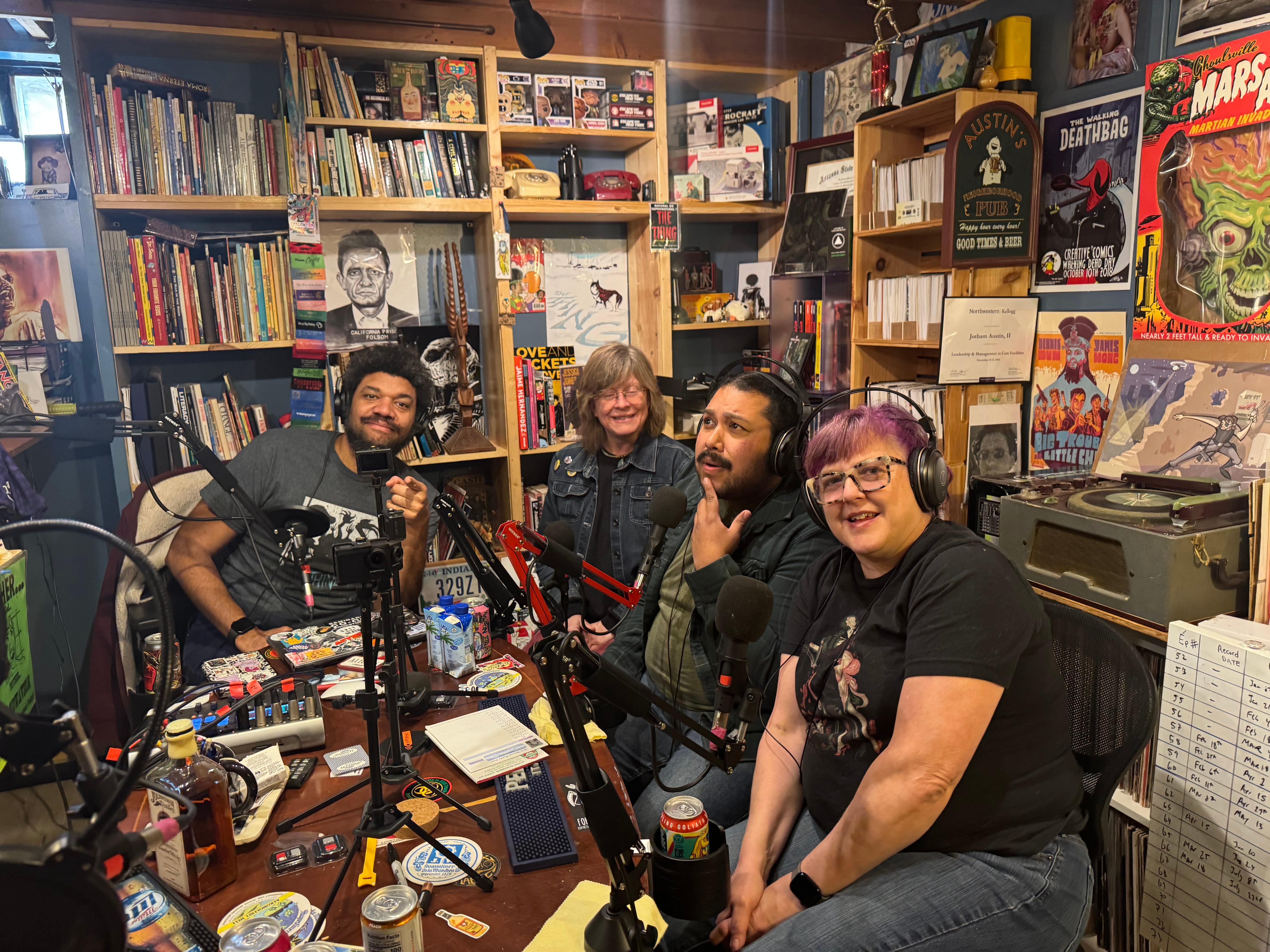
00:00 — Basement Studio Roll Call The whole crew is back together, including Mary, who had to knock on the door to get let back in.
00:41 — Meet Charles Blue Charles introduces himself as a science writer with 35 years of experience, including a stint working with NASA’s Planetary Defense Coordination Office, home of what he calls the coolest job title in the world: Planetary Defense Officer.
03:45 — Why Planetary Defense Matters Joe delivers the opening monologue, setting the stage with a string of real impact events and the question of what happens when Earth’s luck finally runs out.
05:18 — What Counts as a NEO Charles breaks down the difference between asteroids, comets, and near-Earth objects, and explains why the planetary defense community tracks potentially hazardous objects rather than just rocks.
07:41 — Small Impacts, Big Consequences Charles walks through the Chelyabinsk event, explaining why 1,500 people ended up in the hospital — mostly because they ran to the window to watch the flash before the shockwave hit.
09:41 — Global Tracking and Public Alerts Charles explains why keeping an impact threat secret is essentially impossible
11:45 — Tabletop Impact Scenarios Charles describes the real NASA tabletop exercises that simulate government responses to a potentially hazardous object, including one scenario where the cone of probability landed squarely on Washington DC.
14:29 — Budget Cuts, Tools, and Sun Blind Spots The crew discusses the challenge of detecting objects approaching from the direction of the sun, which is exactly why Chelyabinsk went undetected, and raises concerns about what budget cuts might mean for planetary defense.
20:39 — How We Deflect Asteroids Charles walks through the real deflection options, from painting an asteroid white to change its albedo, to the kinetic impactor approach proven by the DART mission.
23:30 — Nukes, Rubble Piles, and Treaties The crew digs into nuclear deflection, the composition problem illustrated by the fluffy rubble pile asteroid Bennu, and the political complications of the 1967 Outer Space Treaty.
27:13 — Movies, Aliens, and The Thing The crew takes a brief detour into favorite science fiction depictions of impact events, with Charles declaring his love for Don’t Look Up, and the entire crew confirming their love for The Thing.
29:27 — Asteroids and the Origins of Life Charles and Joe ponders what it could mean that the Bennu asteroid mission returned samples that contained complex organic molecules including the nucleotide bases of DNA, raising the possibility that asteroid impacts may have helped kickstart life on Earth.
33:28 — Chicxulub and the Dinosaur Extinction Charles explains the Chicxulub impactor hit the worst possible spot on Earth, for dinosaurs, a shallow limestone shelf that vaporized into toxic chemicals, and five seconds later in Earth’s rotation the dinosaurs might have survived.
35:26 — The Oort Cloud and the Heliosphere Mary asks about the Oort Cloud and the heliosphere, and Charles explains the difference between the sun’s protective bubble and Earth’s magnetic field
38:24 — Cosmic Hazards and the Magnetic Shield Charles explains how a gamma ray burst from a distant galaxy was powerful enough to compress Earth’s magnetic field, and why red dwarf stars make terrible neighbors for life-bearing planets.
41:57 — Asteroid Mining Risks Joe raises the question of whether commercial asteroid mining could accidentally nudge a rock onto a collision course with Earth
43:51 — The Psyche Mission and the Gold Rush Fantasy Charles traces the origin of the viral story that asteroid Psyche contains hundreds of quadrillions of dollars of metal, and explains why the engineering reality of actually getting to it makes the headline considerably less exciting.
46:15 — Tabletop Scenarios Revisited Nick asks whether the tabletop exercises are basically just a very serious game, and Charles confirms that the participants control the policy response but not the physics — and that he brought a twenty-sided die just in case.
47:25 — Next-Gen Asteroid Hunters Charles previews NEO Surveyor, launching no earlier than 2027, and the Vera Rubin Observatory — which is already photographing the entire sky every three nights and discovered over 2,000 new asteroids in its first ten hours of observations.
51:52 — How Fast Can We Actually Respond The crew asks for a realistic minimum response time for a deflection mission, and Charles explains that the faster the launch capability, the more options open up, but orbital mechanics still require time that a last-minute discovery doesn’t provide.
53:52 — The Starship Troopers Conspiracy Joe lays out the theory that the Buenos Aires asteroid strike in the 1997 film was a government-engineered false flag to justify war — and Charles is completely on board.
56:07 — Comets in Classic Literature Joe walks through the surprisingly deep history of fictional comet and asteroid strikes, from Edgar Allan Poe in 1839 to Arthur C. Clarke’s The Hammer of God, with Charles adding the story of the 1910 Halley’s Comet cyanide panic.
01:00:23 — Impact Movies and Games The crew runs through the full pop culture timeline from Deep Impact and Armageddon to Asteroids on the Atari, with Charles sharing the story of Seth Shostak’s rejected line from the Deep Impact script.
01:04:38 — Becoming a Science Communicator Charles traces his career from picking up fossils in Pennsylvania coal country to writing about astrophysics, and explains how he ended up getting a butt dial from Vera Rubin herself.
01:08:53 — Curiosity and the Jargon Barrier The crew discusses why scientific curiosity seems to get beaten out of people around middle school age, and Charles makes the case for putting science on the main stage at conventions rather than hiding it down the hall behind the water cooler.
01:16:43 — Black Holes and Big Questions Mary raises the theory that black holes might be wormholes to other universes, and Charles confirms a recent paper suggests this might not actually break the rules of physics.
01:18:41 — Telescopes and Sacred Lands Mary raises the tension between astronomical observatories and indigenous sacred sites, and Charles shares his direct experience working on the Thirty Meter Telescope site selection between Hawaii and Chile.
01:21:53 — Funding Science — The Final Word Charles closes with a call for sustained public investment in planetary defense, noting that having to justify funding for finding asteroids that could end all life on Earth — so someone else can afford a second yacht — is a sentence that should not need to be said.
“Stay curious, stay safe… Love Y’all!”
Join Rabbit Hole of Research on Discord: https://discord.gg/2nnmKgguFV
Subscribe and Share our Substack newsletter to get email updates, never miss an episode, and spread the word!! Don’t forget to give us 5 stars or a like!